


The Encryption Tools node encrypts and decrypts data using standard ciphers — for protecting values at rest, exchanging encrypted payloads with a system that shares a key, or meeting a field-level encryption requirement. Key material is supplied through a connection. Encrypted text is returned Base64-encoded so it is safe to store and transport as text; encrypting a file returns an encrypted file.
Overview
Supported algorithms:
AES — symmetric encryption using a shared key; supports 128-bit, 192-bit, and 256-bit key lengths.
RSA — asymmetric encryption using a public/private key pair; suited to small payloads such as keys or tokens.
AES with hash — AES encryption that also returns a hash of the plaintext for integrity verification.
Warning: The initialization vector (IV) is set on the connection, not generated per call, so every encryption through one connection uses the same key and IV. Identical values then produce identical ciphertext, and with GCM or CTR, reusing a key and IV can expose the plaintext. For repeated encryption, use CBC and add an integrity check with AES with hash and Hash Type set to HMAC. Avoid GCM, CTR and ECB when you encrypt many values through one connection.
Connection
The Encrypt and Decrypt actions read their key material from a connection configured for the Encryption Tools node — the key itself (and, for RSA, the public/private key pair) is stored there, not entered as an action input. The encryption type, mode, padding, and initialization vector used for a given call are also configured on this connection, not on the action itself:
Connection Field | Description |
|---|---|
Encryption type | AES_128 (default), AES_192, AES_256, RSA, or AES_SHA (AES with hash). Must match the algorithm the other side of the exchange expects. |
AES Encryption Key | The symmetric key used for both encryption and decryption: 16 characters for AES-128, 24 for AES-192, 32 for AES-256. |
Base64 encoded key | Check this box if you enter a Base64-encoded key. |
AES initialization vector | Required for GCM, CBC and CTR modes: 12 characters for GCM, 16 characters for CBC and CTR. |
IV is Base64 Encoded | Check this box if the initialization vector is Base64-encoded. |
RSA Public Key / RSA Private Key | The RSA key pair (RSA only). |
Mode | CBC (default), GCM, CTR, or ECB (not recommended). RSA uses ECB. |
Padding | The padding scheme. It follows the mode: PKCS5Padding for CBC and ECB, NoPadding for GCM and CTR; RSA offers PKCS1Padding and OAEP options. |
Tag Length | The tag length for GCM (default 128). |
Hash Type | AES_SHA only: SHA (standard hashing, default) or HMAC (keyed hashing). |
Hash Variant | AES_SHA only: 256 (default), 384, or 512. |
HMAC Key | The secret key for HMAC (required when Hash Type is HMAC). |
Select this connection when configuring the Encrypt or Decrypt action — the action itself takes only the data type and the data to process.
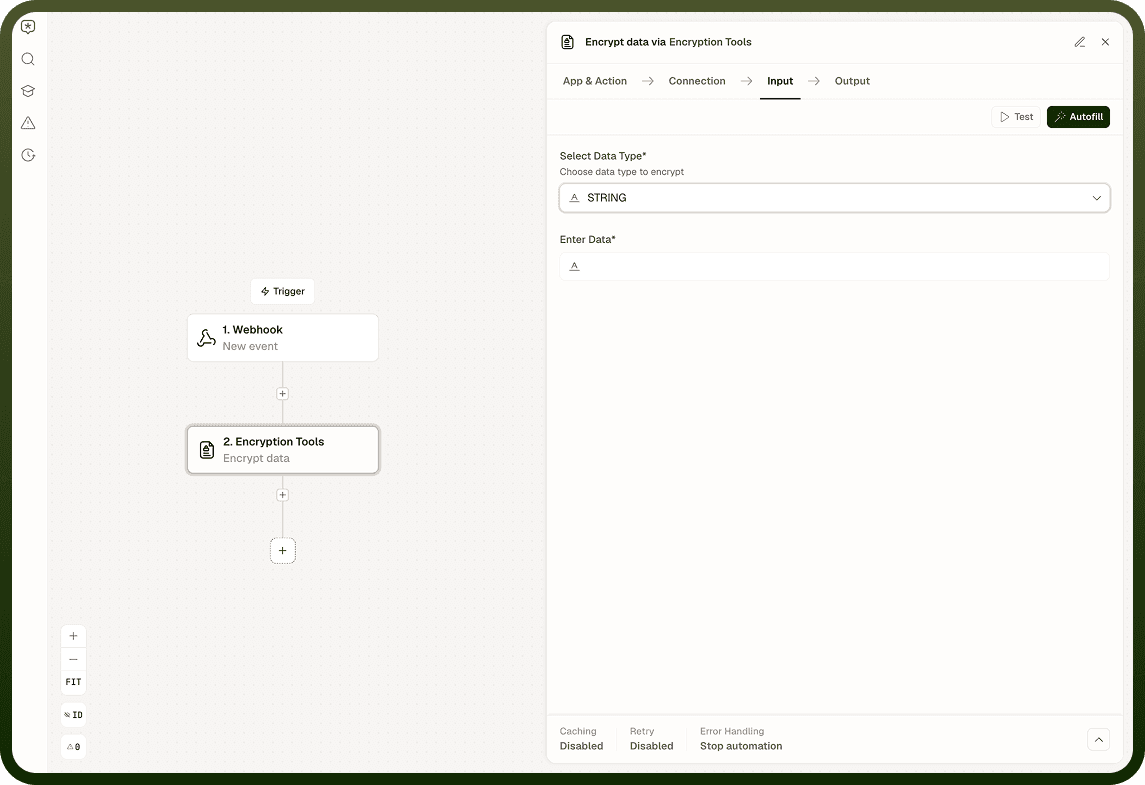
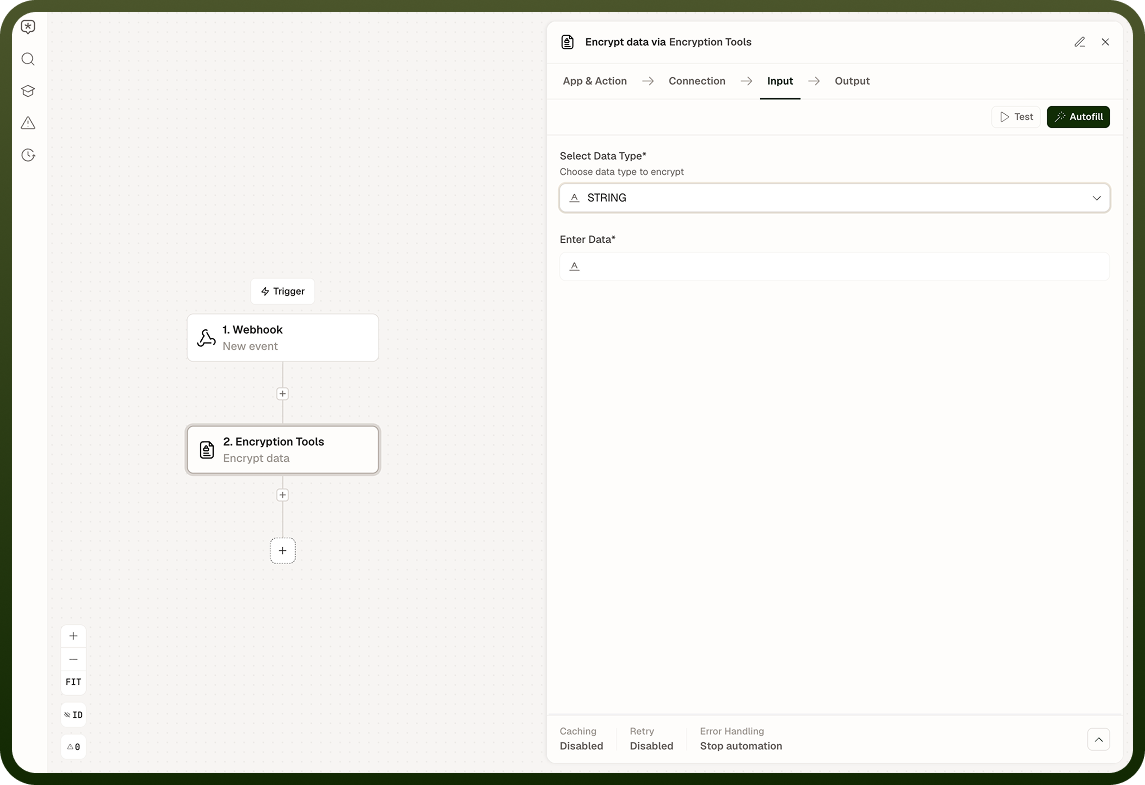
Encrypt
Input Field | Description |
|---|---|
Select Data Type | Required. Text or File. |
Enter Data | The plaintext value, or the file, to encrypt. |
Output: For text, the encrypted, Base64-encoded ciphertext; for AES with hash, also the hash of the original plaintext. For a file, an encrypted file.
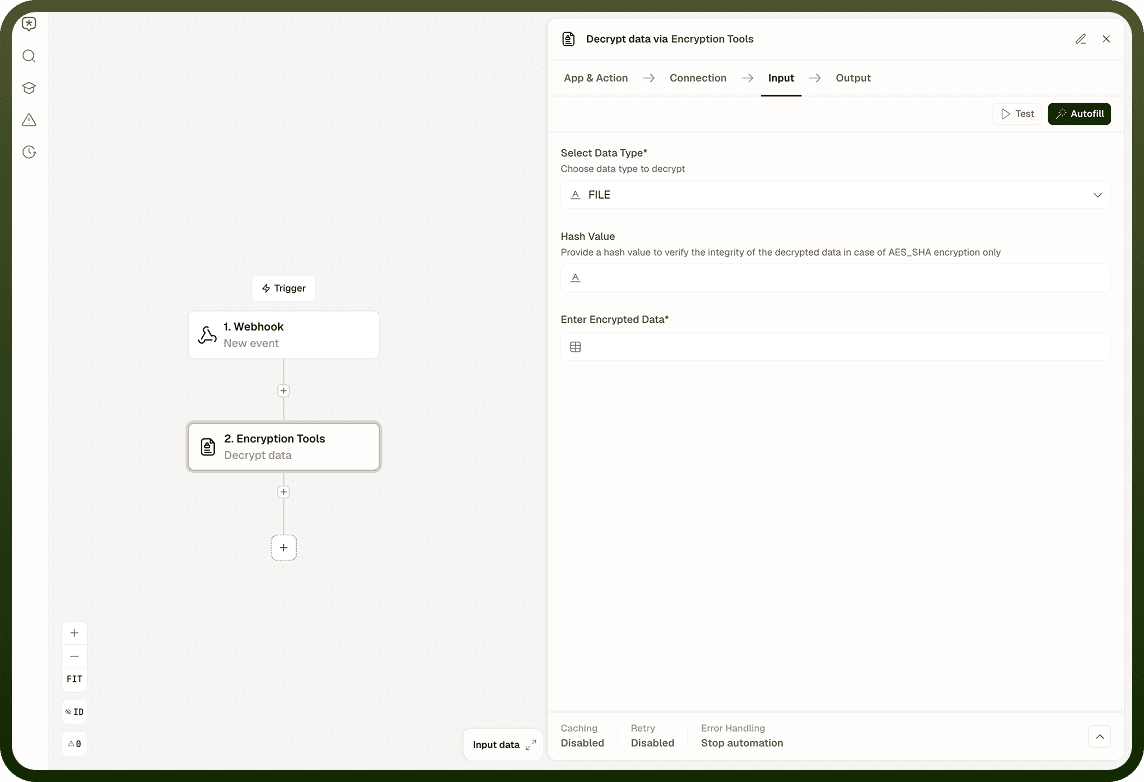
Decrypt
Input Field | Description |
|---|---|
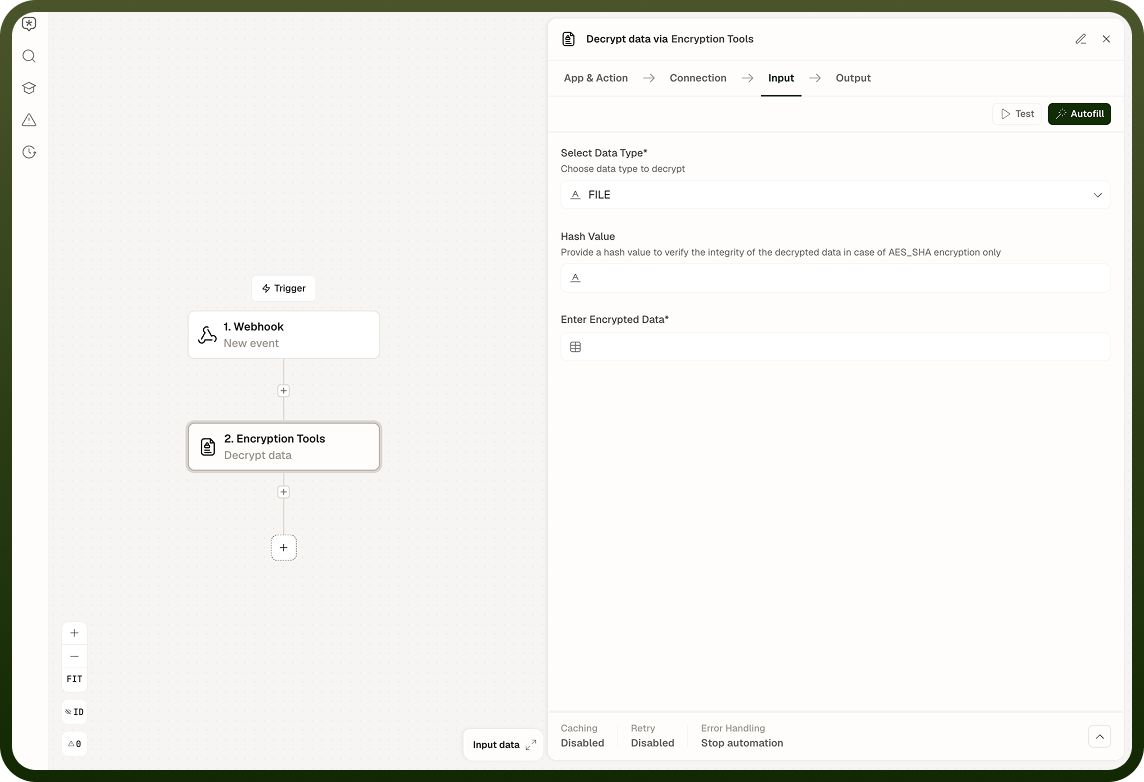
Select Data Type | Required. Text or File. |
Hash Value | AES with hash only: the hash returned at encryption, used to verify the decrypted value. |
Enter Encrypted Data | The Base64-encoded encrypted value, or the encrypted file, to decrypt. |
Output: The decrypted plaintext.
Algorithm and Mode Selection
Option | Guidance |
|---|---|
AES-GCM | Authenticated mode — encrypts and detects tampering without a separate HMAC step. Because the IV is fixed on the connection, avoid GCM when you encrypt many values with the same connection: reusing a key and IV breaks GCM's security. |
AES-CBC | The default mode. Widely supported. Uses padding; does not include tamper detection — add a MAC if integrity matters. |
AES-CTR | Stream-cipher mode; good for large data. No tamper detection built in. Because the IV is fixed on the connection, avoid CTR when you encrypt many values with the same connection: reusing a key and IV exposes the plaintext. |
AES-ECB | Available for legacy compatibility only. Reveals repeating patterns in plaintext. Do not use for new implementations. |
RSA | For small payloads (keys, tokens). Encrypt with the recipient's public key; decrypt with the matching private key. |
AES with hash | Combines AES encryption with a hash of the plaintext. Useful when the receiver needs to confirm integrity of the decrypted value. |
Notes
The Encryption Tools Node works best when you follow these practices:
The key must match the encryption type exactly. An AES-256 key must be the correct length; a key with stray padding or incorrect encoding causes the operation to fail. RSA keys must be in the expected encoded form.
The IV is fixed per connection. It is not auto-generated or entered per call, so every encryption through one connection uses the same key and IV. Prefer CBC with an HMAC check for repeated use, use separate connections where you need different IVs, and avoid GCM and CTR for repeated encryption with one key and IV.
Decryption must use the same IV that was used during encryption. Use a connection with the same key and IV settings on both sides.
Encrypted text is Base64-encoded, and decrypting text expects Base64 input and returns the plaintext. Encrypting a file returns an encrypted file.
Keys and IVs must be stored in the node's connection. Keep them out of logs and plaintext storage.
RSA is not suited to large files. For bulk data, use AES to encrypt the content and RSA only to encrypt the AES key (key-wrapping pattern).