


The Internal API Executor calls UnifyApps' own internal platform API endpoints from within an automation. It is distinct from Custom HTTP, which calls external third-party APIs. This node is an admin-level capability designed for platform-administration automations.
Overview
Use Internal API Executor when an automation needs to interact with UnifyApps' own internal platform APIs — for example, to perform administrative actions that have no dedicated built-in node. It supports the standard HTTP structure: method, headers, query parameters, path parameters, and request body.
Configuration
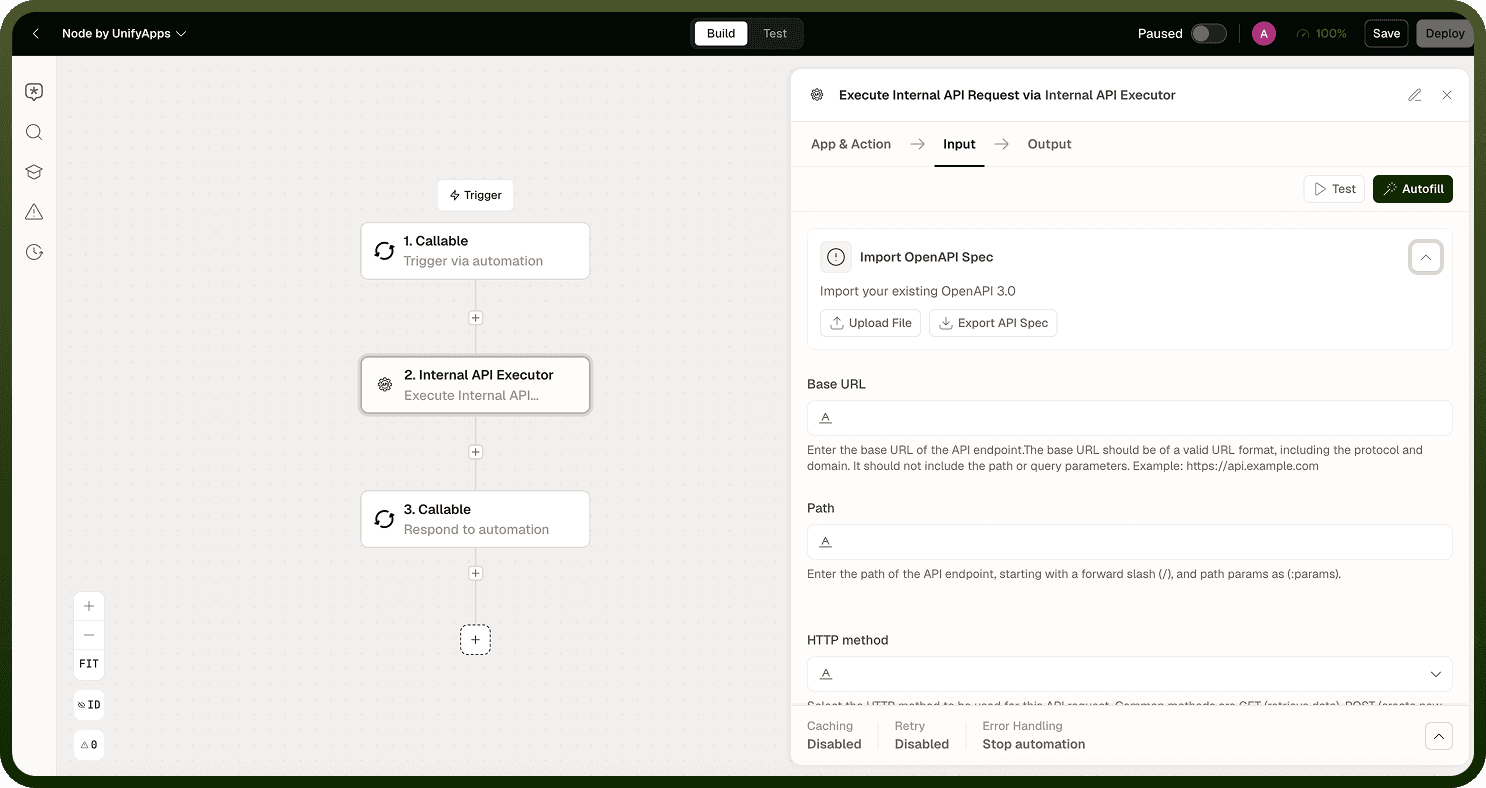
Internal API Executor has a single action, Execute Internal API Request. Configure it with:
Base URL — The base URL of the internal endpoint, protocol and domain only, no path or query parameters.
Path — The endpoint path, starting with a forward slash, with path parameters as
:paramName.HTTP method — GET, POST, PUT, DELETE, and the other standard methods.
Headers, query parameters, path parameters — Added as key/value lists, same as in Custom HTTP.
Request body — The request payload, when the method supports one.
Which internal endpoints you can call, and their exact Base URL and Path, are defined by your platform admin team — this node does not ship with a fixed endpoint catalog. Check with your admin for the endpoint you need before configuring the node. The output returns the response status code, headers, and body, available to downstream steps as data pills; a failed call (for example, a missing permission) returns an error instead.
Note: For calling external APIs and third-party services, use the Custom HTTP node instead. Internal API Executor is intended only for calls to UnifyApps internal endpoints.
Permissions and Audit Logging
The Internal API Executor is an admin-only capability:
The user running the automation must hold the Execute Internal API permission (under Roles & Permissions), or the call fails.
Every call is audit-logged — this cannot be disabled. Each call is recorded in the audit log with the URL called and the user who ran it.
Treat this node as a privileged tool. Keep its use intentional, limited to legitimate platform-administration needs, and ensure your team is aware that all executions are logged.
Notes
The Internal API Executor works best when you follow these practices:
Keep its use intentional and limited to legitimate platform-administration needs — every call is audit-logged and cannot be made silently.
For any external API call, use Custom HTTP instead.